


In 2017, I asked my employer to fund a podcasting conference as professional development.
My request got denied.
I worked in organisational development and had become obsessed with podcasts as a learning medium. The conference felt like a chance to understand the craft from the inside.
But fair enough. I guess it wasn’t immediately transferrable to my role.
However, I was still keen to go.
So I requested annual leave. I paid for my own ticket and I went anyway.
That decision changed my life.
You gotta be in it to win it
At the conference, there was a raffle to win a book by author Andrew Griffiths. To enter, you had to write your podcast name on a piece of paper and drop it in a hat.
Slight issue:
I wanted to win the book.
…But I didn’t have a podcast.
Because I really wanted that book, I sat there thinking about some advice I had learnt at the conference: If you want to start a podcast, make it about something you want to learn more about. That way you’ll keep going, even if no one listens to it.
At the time, I was running workshops and figuring it out as I went.
So I wrote “First Time Facilitator” on a blue Post-it note and dropped it in the hat.
I made myself a deal: if my note gets pulled, I’m creating the show.
A few minutes later, Andrew was on stage. He reached into the hat and it was like slow motion.
He pulls out a blue Post-it note.
“Congratulations Leanne Hughes, podcast host of First Time Facilitator, come down and tell us what your show is all about!”
WHAT THE..!
I had thirty seconds to scramble, get to the front of the room and explain a podcast that didn’t exist.
I can’t even remember what I said.
But I played along and explained the premise of my fake show.
I turned that lie into the truth a few months later, releasing the First Time Facilitator on Apple Podcasts.
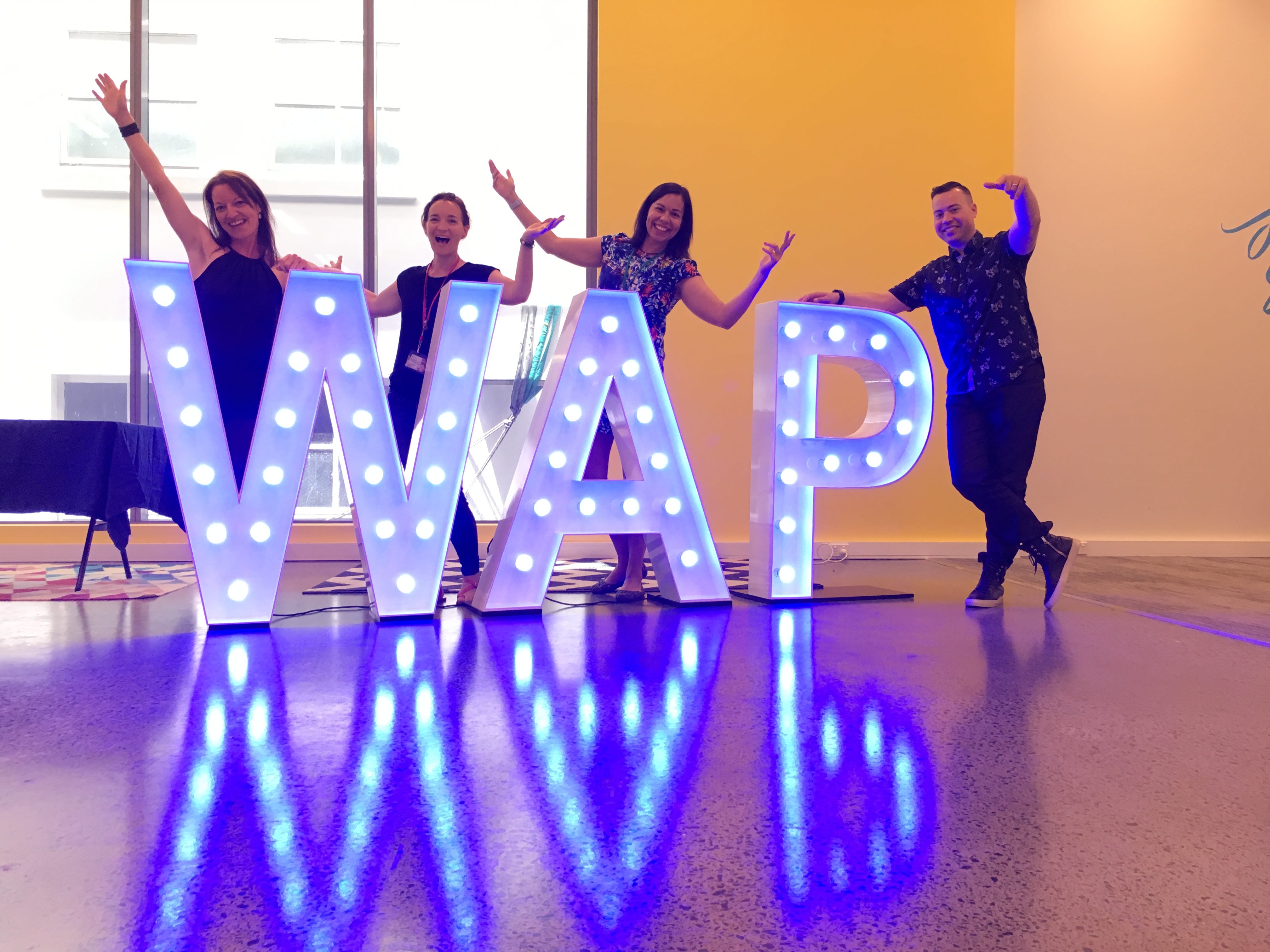
The wrong question everyone asks
Before committing to any event, conference, or training program, someone always asks: “What’s the Return On Investment (ROI)?”
It’s a totally fair question.
I ask myself the same thing.
But it’s also the wrong question.
Sure you can read the event, training or session outcomes and say, “Okay, as a result of attending this event, I’m going to 10x my income!"or, “I’ll learn how to use AI to slash my working hours to 2 hrs/day and retire next month!”
But that’s all false because the ROI of any event is something you create - what you will do, who you will meet, what you will personally extract from the experience.
Two people can attend the exact same conference:
One leaves with a handful of new LinkedIn connections and some great travel footage for Instagram Stories.
The other leaves with a powerful new identity.
The event is raw material/stimulus.
The ROI of any room you walk into is determined by you.
A quick caveat: I'm not saying sign up to everything. Obviously, do your homework first. Check who's running it, who's speaking, whether the content actually aligns with where you're headed. The point isn't blind enthusiasm. It's that once you've decided something is worth attending, don't outsource your ROI to the organisers. That part's on you.
How do you extract value from attending an event?
Here are some things that I’ve done in the past:
Do some prep. Look up speakers and fellow guests, send a connection request that includes that you’re attending the conference.
Organise your own side quest. Think about dinners, coffees or walk and talks you could host outside of the official learning times. Or, host a little thing for contacts in that city that aren’t going to the event.
Stay a little longer: If you’re travelling even staying an extra day helps you consolidate/commit to action before arriving back in the real world. But even if it’s on your ‘home ground’, you can put this buffer in your calendar, too.
Decide the output before you attend… or maybe not even that. Block time in your calendar over 30 days post-event for taking action, so you’re committing to implementing something.
Volunteer at the event. Offer to introduce a speaker, host a table discussion, or summarise key takeaways for the group. Hosting gives you access.
Really listen to the other questions people are asking and how they’re describing their challenges/opportunities. It gives you good intelligence as to what’s going on around you, and potential content or business ideas.
Follow up within 48 hours. Send a voice note or short message to the people you connected with while the energy is still fresh.
Debrief with someone who wasn’t there. Explaining what you learned to a colleague or friend forces you to distil your key learnings. Or, scale that by writing an article like this!
What would you add to the list?
One more thing
I hear people occasionally say, “Oh, I’d really love to build these skills and do that PD but my company won’t pay for it”.
Nooooo. If I’d waited for my company to approve that conference, I wouldn’t be writing to you right now.
I love this quote from Jim Rohn
If you don't design your own life plan, chances are you'll fall into someone else's plan.
And guess what they have planned for you?
Not much.
You are the only person who will advocate for your growth with the intensity it deserves.
Back yourself to extract the ROI.
🌴
Leanne “Mining for ROI” Hughes
My ROI formula for an event is very simple.
1. Ask, "What is my challenge (or desire) right now?" (Name it, associate into it)
2. Walk into the room on Day 1, or Hour 1, assuming that the answer is in the room (maybe not from the front of room; it might be amongst other participants)
3. As I leave, ask, "What do I know know / understand / feel differently about, that relates to my challenge?"
4. Once I'm at home / back at work, do ONE THING to activate it. It might be: use a particular phrase in a proposal, call someone, redesign a common slide I use in workshops etc etc.
That's worked pretty well for me for decades.
I'm a big fan of self-funding PD, and these days it's rarely about the people on stage, it's the people who are likely to attend and the conversations that will be sparked. I've often added a day or 2 after the event (especially the big ones where I've travelled), if for no other reason than to stay in the 'reflection and creation' bubble' before re-entering everyday routines.
And I LOVE that first time facilitator was created to enter a lucky door comp to win a book about writing books. So deliciously meta 😅