


We all know tech is moving fast, AI, AI, blah blah blah…
And if you’re feeling like everyone else has figured it out, you’re not the only one. Today, I thought I’d share how I try not to feel extinct, even as a 42-year-old elder millennial.
I jumped on a LinkedIn Live yesterday with Lisa Mulligan to talk about this exact thing (watch the replay here).
Here are five ideas that emerged from our conversation.
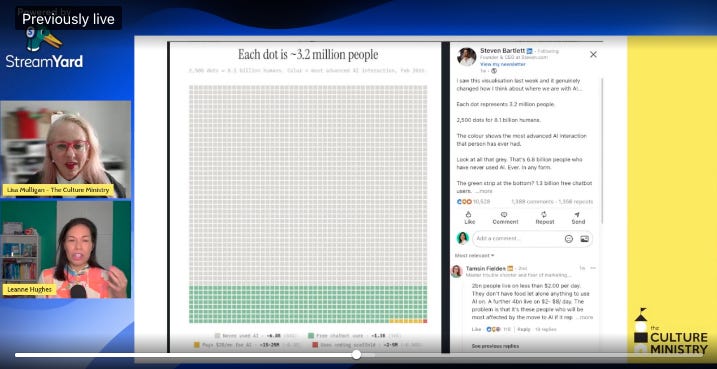
1. Resilience? So 2025. This is the other ‘R’ skill that matters.
I think the critical skill right now is resourcefulness. Resourcefulness puts you on the front foot, it’s proactive and it means you go out and find the thing before someone hands it to you. You teach yourself and you solve problems with whatever you have available.
(The anti-resourceful person gets sent to this website).
Almost everything you need to learn is free - all of the tools have free tier, tutorials are on YouTube, communities are open. The barrier to entry has never been lower.
2. Focus on “what” not “how”
I mean, this isn’t new - Covey wrote about it “Begin with the end in mind”.
Begin with what you want to achieve, then work backwards and use AI to help you get there. We’re in the no-code era. You don’t need to understand how AI works under the hood. That’s the best part. Don’t tell AI exactly how to do something. Tell it what you’re trying to achieve and let it work out the route.
If you go in dictating the method, you might end up recreating an old process when a better one already exists, especially as LLM models keep improving. Ask AI to recommend tools, suggest a sequence, or map out the steps.
3. Make it lighter (without the laptop)
One mistake I made was thinking I had to be on my laptop to use AI properly.
I associated it with sitting down at a desk, opening tabs, and doing serious work, which meant it started to feel a bit boring, like homework. And boring is a barrier.
What’s worked better for me is using AI on my phone, in real life, while I’m out and about, for example:
Yesterday morning, I printed out my book manuscript and instantly felt overwhelmed. Then I thought, hang on.
I opened ChatGPT on my phone and said, “I’ve got this manuscript, it’s due Monday morning, today’s Thursday. How do I get this right?” Within minutes, I had a project plan, a colour-coding system, and clear steps for each day.
Lower the friction. Don’t make AI a formal event. Make it something you can reach for in the moment you need it.
4. Give yourself credit - you’re probably using more AI than you think
Many of us don’t realise we’re already using AI with our existing tools.
Lisa shared research from PwC, Harvard Business Review, Stanford, and Berkeley that share the same pattern - women’s adoption of AI tools sits around 25% lower than men on average. Women are more likely to report never using AI tools at all.
I saw those stats and wanted to explore them.
If you have an iPhone and you’ve ever typed “dog” into your photo search bar, the technology that finds all your cute photos is AI. It’s already embedded in the tools you use every day, we just don’t always call it that. A lot of your favourite apps are quietly embedding AI into how they work.
You’re already in the game, way to go!
5. My three-pronged approach to staying in the loop.
If you’re wondering where to practically start, here are three things that have worked for me. I call them the three Ps (quick video below)
People. Find your people and let the algorithm do the rest. If you go onto YouTube and search for AI content, there are creators out there who will completely repel you. It can be very bro-ish. But within that same algorithm, there are people where you’ll think, oh, I resonate with this person and their approach.
Once you find that one person whose style clicks with you, then the algorithm starts serving up more of that kind of content, and before you know it, you’ve built yourself a curated feed.
Also, organise AI Jams with your friends colleagues / jump on calls and share what you’re doing behind the scenes (my friend Andy Storch did this recently with his community and raved about it).
Podcasts. Podcasts are your secret weapon here, and not for the reason you’d expect. Yes, you can listen on the go. But the real value is what happens when something lands and you hit Pause (another P word!). When you hear an idea, stop. Ask yourself: how would I apply what I just heard to a challenge I’m already facing?
A lot of tech creators share examples that won’t be relevant to your world. So the skill is translating that to your own context. I find I’m pretty good at this when I’m out walking. I recommend listening to Greg Isenberg, even one episode of “The Startup Ideas Podcast” will get your wheels turning.
Play! Subscribe, cancel, and play. Jump in and try to break the tool (hard to do!) but just give it a go, have fun, experiment.
One practical tip: when you find a new tool you want to try, pay for the subscription and cancel it immediately. You’ll still have access for the full 30 days, but you won’t get charged again if you forget about it.
Okay, that’s a bit of a summary of what we shared during the call.
I’d love to know which Point (1 → 5) you like to use the most when you approach new tech / a new thing?
ONE MORE LIVESTREAM THIS WEEK:
Jump in and join Alan Weiss and me for our latest Talk the Walk LinkedIn livestream. It’s on Thursday 12 March 4pm ET (US), and Friday 13 March 6am AEST (Australia).
🌴
Leanne “Elder Millenial” Hughes
p.s. If any of this was useful, hit the heart 💙 (or get your AI agent to do it - no judgment here).
This is such a great summary Leanne. Thanks for joining me on the LinkedIn live yesterday!